On the Textual Uniqueness of Scripture
Internal consistency, cross-referential depth, manuscript accuracy, and the comparative case for Biblical reliability: plus a section on flood geology as a case study in how to approach scriptural and scientific claims.
Overview
What follows is taken from an email answering specific questions I received on a phone call. This was sent to someone who said they would use my email as a starting point to research various topics, so while I wanted to give a solid foundation from a data, science, and logical threshold, I also wanted to give a variance of places to begin their quest for truth.
Part 1: Internal Consistency and Cross-Referential Structure
The 63,779 Cross-References
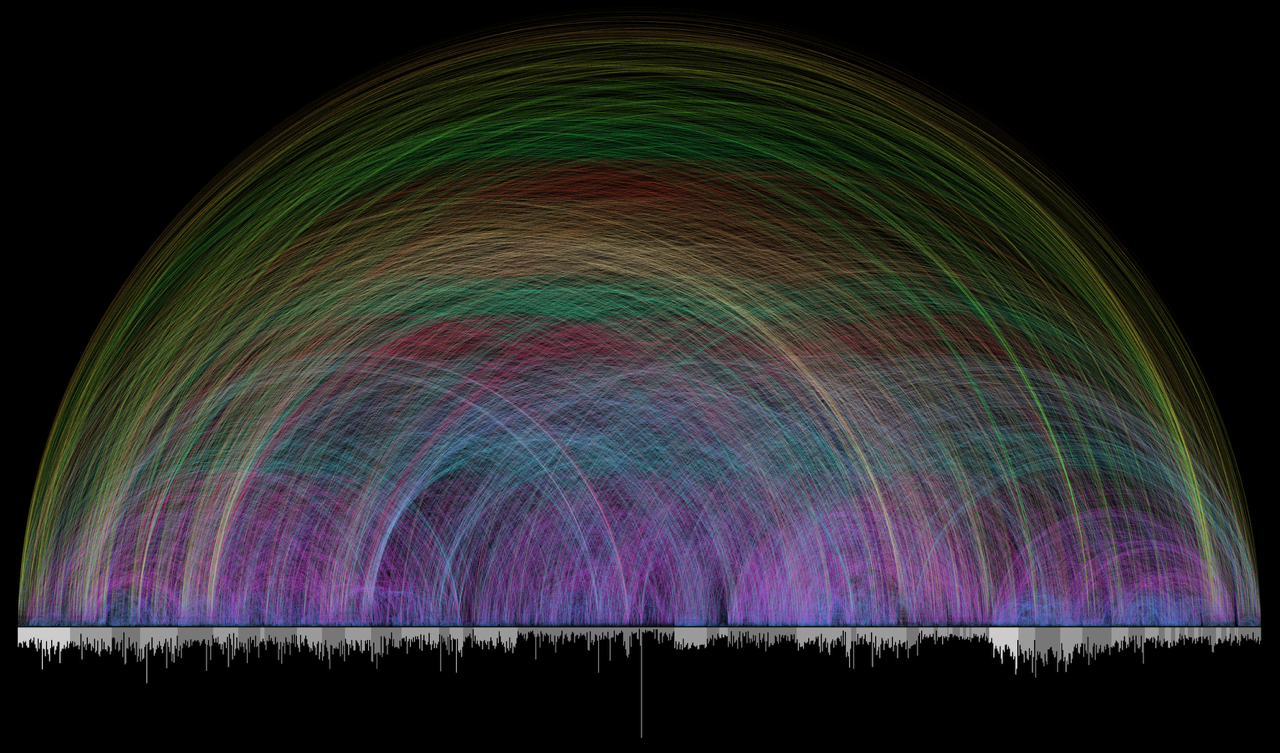
Alright, here is a collection of works on textual uniqueness of scripture. Starting with a fantastic chart that creates a visual representation of the connectedness of the Bible (63,779 cross-references):
“The bar chart that runs along the bottom represents all of the chapters in the Bible, starting with Genesis 1 on the left. Books alternate in color between light and dark gray, with the first book of the Old and New Testaments in white. The length of each bar denotes the number of verses in that chapter (for instance, the longest bar is the longest chapter in the Bible, Psalm 119). Each of the 63,779 cross references found in the Bible are depicted by a single arc - the color corresponds to the distance between the two chapters, creating a rainbow-like effect.”
Comparison: The Quran
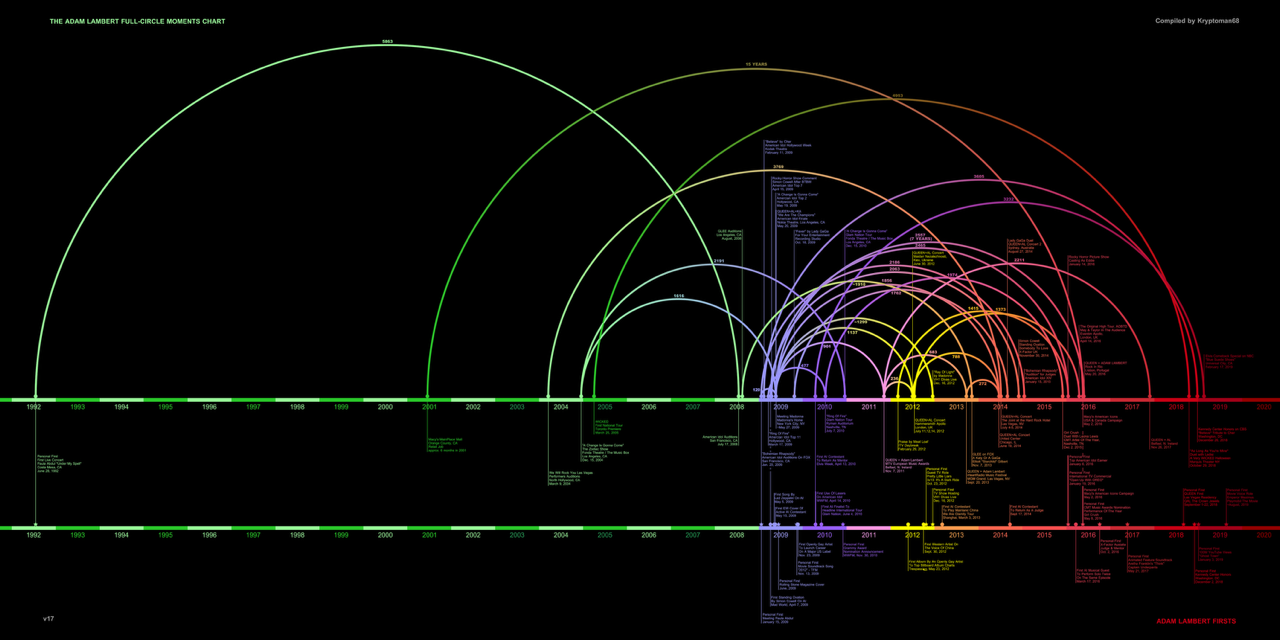
To compare, there has been a recent attempt (after the above chart came out) to show how interconnected the Quran is, and there has not been a chart for theirs because it would have had only somewhere less than 600 cross-references (maybe significantly so): iqsaweb.org. It would end up looking similar to the Adam Lambert music loop chart and appears underwhelming in comparison (included for scope reference):
The comparison is not offered as a dismissal of the Quran’s significance to its adherents. It’s offered as a data point about what makes the Bible’s internal connectivity structurally unusual, particularly given that its 63,779 references span a text composed by dozens of people across millennia who, in many cases, could not have read each other’s work.
More so, this emphasizes that the Quran is a book written by a single individual over a span of 23 years, in a single language and written in a single location. Whereas the Bible was written over a span of over 1600 years by 40 different contributing authors, across three languages, and written across three continents, yet despite this, it shows significantly more internal consistency. Also, many of the New Testament sections were written congruently by different contributing authors without the knowledge of the other (and across two continents) and they still cross-reference each other.
The Prophecy Layer
In the scriptural one above, over 300 of those references alone are from the Old Testament and are prophecies relating to Jesus and how you will know Him when He comes (with several of those prophecies occurring 900 years before his birth, the earliest about 4,000 years before His birth, and the latest ones still occurring around 300-400 years before his birth). So there are almost as many prophecies regarding Jesus alone as there are entire cross-references in the entirety of the Quran.
| Scholarly Resources — Internal Consistency & Cross-Reference | |
|---|---|
| Andrews University Biblical typology and cross-reference | Peer-reviewed treatment of the self-contained consistency and referential structure — digitalcommons.andrews.edu |
| Liberty University Digital Commons | Academic treatment of scriptural internal consistency and cross-referential architecture — digitalcommons.liberty.edu |
Part 2: Textual Criticism — How Accurately Was the Text Transmitted?
What Textual Criticism Is
Textual criticism focuses on how we know the version we have is accurate compared to the original for works published before we have easy ways to verify it or before we have existing verifiable first editions. For example, Homer is often cited as it is a classic work that is closest to its original, yet our earliest copy is still 600 years removed from the original. The histories of Alexander the Great are often regarded as some of the most accurate because of how close they were written from when he lived, yet our earliest copies date to more than 300 years after he died. Whereas, in relation to the New Testament and the life and resurrection of Jesus, we have copies from within 30-60 years of his death, meaning these copies existed at a time when people would have still been alive who could have challenged them. Yet we have them from scriptural sources (Luke, Mark, Mathew, John), as well as non-Christian historians (Josephus, a Jewish historian; Pliny, a Roman Governor; Tacitus, a Roman historian; Suetonius, another Roman historian; among others), each of whom was writing within 20-90 years after Christ’s death and our earliest copies of each of their works dates to within 40-80 years of its publication.
The Comparative Picture
| Criterion | Bible | Quran | Homer (Iliad) | Alexander histories |
|---|---|---|---|---|
| Authors | ~40, over ~1,600 years | 1 (Muhammad), ~23 years | 1 (attributed) | Multiple, near-contemporary |
| Languages | 3 (Hebrew, Aramaic, Greek) | 1 (Arabic) | 1 (Ancient Greek) | Greek |
| Continents written | 3 (Africa, Asia, Europe) | 1 (Arabian Peninsula) | 1 | 1–2 |
| Internal cross-refs | 63,779 documented | ~500–600 estimated | Limited | Moderate |
| Earliest surviving copy vs. original | NT: 30–60 yrs | ~150 yrs after Muhammad | ~600 yrs after composition | 300+ yrs after Alexander’s death |
| Manuscript copies | 600,000+ | Fewer comparative MSS | ~1,800 | Dozens |
| Significant variants | ~3–4 (none alter core doctrine) | Variant early traditions; significant burn/standardize campaign under Uthman | ~2,400 lines of variation | Substantial |
The Variations That Do Exist
The above links dive into these types of works as well into the accuracy of the scribes in making their copies as they made new printings before the printing press and how small mistakes can often end up corrupting these works by changing meanings, important sections, or even through intentional changes by scribes acting in bad faith or out of their own selfish motivations… despite the significant amount of biblical manuscripts (over 600,000) and the significant timeframe from which they were written, there is an incredible amount of accuracy from the earliest manuscripts to the latest copies with often no variations at all, but where variations do occur, it is almost always a trivial spelling difference. There are less than 2 dozen differences that might be considered to have any impact on the text, and of those, most don’t impact the meaning of the context in the verse or chapter. There are maybe 3-4 variations that might be considered impactful in the slightest, but none of those 3-4 change any of the core tenants or purposes (two of them have sections not present in one manuscript that are in another… most likely these sections exist in an older manuscript not yet found and were left off of one in-between as has been discovered on other sections like this in the past that were later discovered in older manuscripts that were discovered after, but as of now, those 2 sections are the only ones still up in the air.
Non-Christian Historical Corroboration
The historical existence of Jesus and the early Christian movement is attested by multiple non-Christian sources writing within 20–90 years after his death:
Josephus — Jewish historian, writing roughly 60–90 years after Christ’s death. Our earliest manuscript copies of his work date to within 40–80 years of its original publication.
Pliny the Younger — Roman governor, writing approximately 80 years after Christ’s death.
Tacitus — Roman historian, writing approximately 80–85 years after Christ’s death.
Suetonius — Roman historian, writing approximately 80–90 years after Christ’s death.
Each of these writers was hostile or indifferent to Christianity and had no interest in confirming Christian claims. Their references are therefore corroborating evidence rather than advocacy.
| Textual Criticism Reading | |
|---|---|
| Lee Strobel — The Case for Christ · Amazon | Accessible, narrative-level introduction. Written for a general audience (approximately 8th-grade reading level). Has been criticized for not engaging some of the deeper technical debates, but is a solid entry point if you’d rather start here and only dive deeper if you feel you need to get the more thorough technical scope. |
| Bart Ehrman / Daniel Wallace — Revisiting the Corruption of the New Testament · Amazon | Post-graduate level scholarly work. Engages the textual variation questions directly and rigorously. The more technical link. |
On the Overall Argument
Now, we can compare that to any historical book written pre-printing press, and no other book of any kind, significant or not, has that level of scribal accuracy, or recency compared to original publishing date, or internal consistency and cross-referencing. Or, as I challenged on the phone, compare to even modern histories with completeness of the history and inherency of the work vs trying to force a specific political view and missing the internal consistency with known facts that often contradict that view.
Part 3: Flood Geology — A Case Study in How I Approach Scriptural and Scientific Claims
Secondarily, to show the accuracy of scripture even about topics that are more controversial I like to start with the big one: Noah’s Flood. Before I share the links here, how familiar are you with Ptolemy and his theory on the motion of heavenly bodies? In short, this was the dominant astronomical theory for over 1,400 years and was based primarily on trigonometry to predict the motion and location of the planets, etc… In short, it put each planet on a “circle” and related those circles (spheres) movements together, over time, whenever there was a gap or inconsistency, “they” solved it by adding smaller circles in-between the larger ones… the original theory started with only a few circles of motion, but ended up with over 40 types of circles encompassing well over 200 individual circles. Similarly, the theory of plate tectonics started with only a few plates to describe the movement of the continents, but over time to fill in gaps “they” have added smaller plates to solve inconsistencies. Essentially, it’s been known for about 50 years now that plate tectonics is bunk, but there hasn’t been a new model to come along that’s been generally accepted to replace it like there was with the Ptolemaic model being replaced with Copernicus Heliocentric model.
The Alternative I Find Most Compelling
That said, this is what I consider to be the best theory on plate tectonics… there are some potential issues, but they are relatively minor. The biggest set of criticism I’ve seen was from a physics professor out of Colorado, but 98% of his issues were explained in the documentation, so it felt like he was arguing against his own assumptions about the theory rather than the theory itself. He had just one area of criticism that seemed to hold up and it had to do with the amount of vapor and its exit speed, essentially, more water would’ve ended up in space than this theory suggested, but that doesn’t impact almost anything of the rest of the theory or its outcomes.
| Flood Geology Resources | |
|---|---|
| Walt Brown — In the Beginning (full text online) · creationscience.com | Brown’s complete hydroplate theory, available to read in full online or order in print. Detailed and extensively documented. |
| YouTube series on hydroplate theory · YouTube | Video presentation of the core arguments. The presenter can be a little dry. Useful companion to the book. |
On the Overall Argument
Now, we can compare that to any historical book written pre-printing press, and no other book of any kind, significant or not, has that level of scribal accuracy, or recency compared to original publishing date, or internal consistency and cross-referencing. Or, as I challenged, compare to even modern histories with completeness of the history and inherency of the works vs trying to force a specific view and missing the internal consistency with known facts. [I’ll add links to inconsistencies here: ]